


 Leader Board
Manitowoc Crane Repairs: Installation Discipline Matters
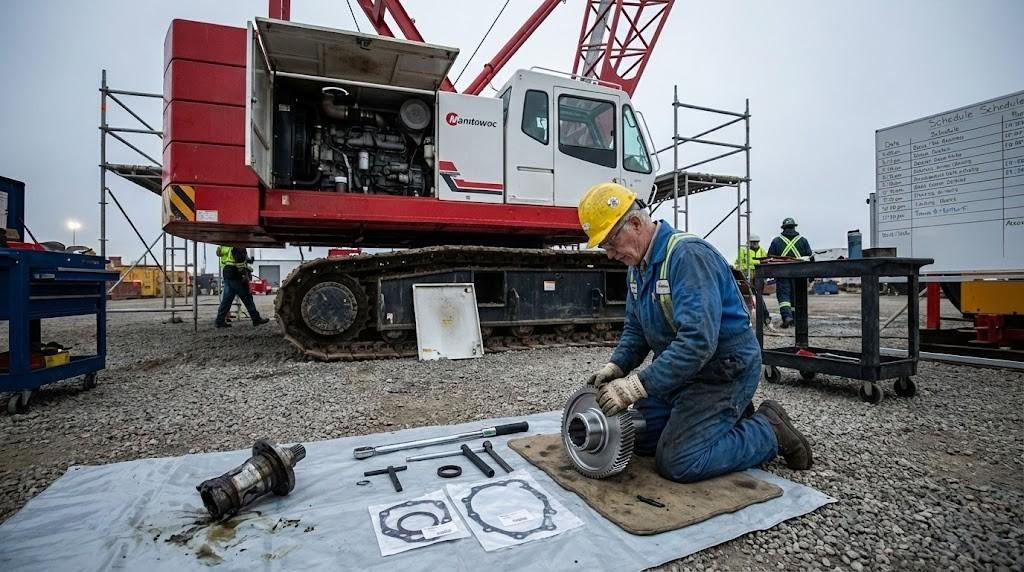
When a Manitowoc crane ceases operation, the maintenance organization faces a crucible. Operational pressure mounts with every passing minute, project timelines hang in the balance, and the team must deliver solutions under intense scrutiny. Yet this urgency—however understandable—often becomes the direct cause of future equipment problems.
The insidious nature of installation errors is their delayed manifestation. They rarely produce immediate, obvious breakdowns. Instead, they establish conditions where component wear accelerates quietly, surfacing as failures weeks or months after the original repair. When these secondary problems occur, the replacement component typically receives undeserved blame while the true culprit—compromised installation—remains concealed.
Recognizing where installation discipline most commonly deteriorates helps maintenance teams protect their investments and establish genuine equipment reliability. Here are five critical errors that undermine even quality Manitowoc parts, along with practical strategies to ensure lasting repair success.
The Verification Vacuum
New components arrive with an implicit assumption of readiness that creates significant vulnerability. Manufacturing variability, shipping damage, and packaging errors occur with sufficient regularity to justify rigorous verification procedures.
Before installation begins, technicians must confirm part numbers against technical documentation and physically compare replacement components with removed units. Mounting geometries, connector configurations, shaft dimensions, and overall form factor require careful examination. Even quality Manitowoc parts can arrive damaged, mislabeled, or incorrectly specified.
Simultaneously, the crane's receiving interfaces demand thorough assessment. Worn mounting pads, distorted brackets, contaminated hydraulic ports, or compromised electrical connections will degrade new components immediately. Installing fresh parts onto damaged infrastructure doesn't restore system integrity—it transfers stress concentrations that accelerate the next failure cycle.
The discipline of comprehensive verification, typically requiring under ten minutes, consistently prevents troubleshooting marathons that consume hours or days.
Precision Sacrificed to Schedule
Torque specifications and alignment requirements represent engineering decisions based on comprehensive analysis of operational stresses and material capabilities. Treating these specifications as flexible targets introduces systematic failure modes.
Under-torqued fasteners permit micro-movement generating fretting wear, fatigue cracking, and progressive loosening. Over-torqued hardware stretches threads beyond yield strength, deforms bearing races, and creates stress concentrations that propagate cracks under cyclic loading. Both conditions develop without immediate symptoms, making them particularly insidious.
Alignment precision carries equivalent importance. Pumps, motors, swing drives, and gear trains require exact positioning to distribute operational loads evenly across bearing surfaces. Minor misalignment might permit immediate operation, but it establishes uneven loading patterns that dramatically accelerate wear and reduce operational life.
The full performance potential of quality Manitowoc parts is realized only when installation tolerances are respected exactly. Approximation is a mindset that consistently produces expensive consequences.
The Hardware Reuse Fallacy
Visual assessment of fasteners and seals creates dangerous overconfidence. Components appear serviceable when examined superficially—bolts seem straight, washers look undamaged, seals show no obvious defects. This appearance ignores material degradation that occurs through operational exposure and previous service cycles.
Fasteners experience work-hardening, stress relaxation, and fatigue that alter their mechanical properties. Each installation cycle changes thread engagement behavior. Seals lose elastic recovery after thermal cycling and chemical exposure. Gaskets compress permanently and cannot reseal effectively regardless of visual condition.
These degraded components may function initially, but their compromised condition creates elevated failure risk under operational loads. Hydraulic systems, rotating assemblies, and load-bearing structures particularly demand complete hardware replacement with every major component installation.
When working with a crane parts supplier, specify complete installation kits including all consumables. The incremental cost is negligible compared to the labor and operational impact of premature failure.
Integration Oversights
Many technicians incorrectly treat physical mounting as repair completion. In reality, component installation represents approximately half of a complete repair process for modern Manitowoc equipment.
Contemporary systems incorporate electronic sensors, transducers, and control modules requiring specific calibration, resetting, or configuration procedures after component replacement. Omitting these steps produces erratic system behavior, false alarms, or degraded performance that appears to indicate component defects.
Even purely mechanical replacements demand comprehensive operational verification. Complete cycling through all motion ranges, pressure verification against specifications, temperature monitoring under working loads, and attentive observation for abnormal vibration or acoustic signatures should be mandatory before equipment release.
Abbreviated testing transfers risk to equipment operators and creates the intermittent fault scenarios that frustrate diagnostic efforts and erode operational confidence. Thorough integration validates repair quality and prevents downstream complications.
Neglecting Root Cause Investigation
Components fail through specific physical mechanisms driven by underlying system conditions. Contaminated hydraulic fluid, structural misalignment, overload conditions, lubrication deficiencies, or system imbalances create the stress that destroys parts. Replacing the failed component without addressing these root causes simply resets the failure countdown.
A hydraulic pump installed without system flushing enters the same contaminated environment that destroyed its predecessor. A bearing replaced without correcting shaft misalignment inherits the same destructive loading pattern. A sensor swapped without inspecting wiring integrity will exhibit the same intermittent faults.
Professional maintenance discipline extends beyond identifying what failed to understanding why it failed. This analytical rigor, consistently applied, transforms repetitive repairs into permanent solutions and builds genuine equipment reliability.
Managing Environmental Pressure
Installation errors rarely reflect technical skill deficiencies. More commonly, they result from environmental pressure that erodes procedural discipline. Schedule constraints, weather limitations, and operational demands create urgency that makes shortcuts increasingly attractive.
The maintenance professionals who achieve consistent, durable repairs maintain methodical adherence to proper procedures regardless of external pressure. Their disciplined consistency protects equipment integrity more effectively than rushed speed. The wisdom to maintain standards under pressure distinguishes truly professional practice.
The Quality Imperative
Even perfect installation technique cannot compensate for substandard components. This fundamental constraint makes part quality a prerequisite for maintenance success. Quality Manitowoc parts maintain original equipment specifications, ensuring dimensional accuracy, appropriate materials, and predictable performance characteristics. When diagnostic challenges arise, genuine components simplify troubleshooting and accelerate resolution.
Partnership with an established crane parts supplier extends quality benefits throughout the maintenance process. Knowledgeable suppliers assist with revision verification, compatibility confirmation, and awareness of known installation considerations before work commences. This preparatory support frequently prevents errors that would otherwise surface during installation or initial operation.
Markers of Professional Excellence
Superior installations share characteristics that become visible over time: they don't generate repeat service calls. Equipment resumes operation without fluid leaks, electronic alarms, or unexplained performance variations. This seamless return to service isn't fortunate coincidence—it's the predictable outcome of systematic inspection, precise torque application, careful alignment, fresh hardware implementation, thorough system verification, and root-cause analysis.
These practices require additional time investment upfront. They deliver returns many times over through extended component life, reduced emergency repairs, improved equipment availability, and enhanced maintenance organization reputation.
Final Considerations
Installing components in Manitowoc cranes should enhance reliability and extend service life, not introduce fresh failure modes. The majority of premature component failures attributed to manufacturing defects actually originate in installation shortcuts driven by operational pressure.
Eliminating the five critical errors—verification shortcuts, precision compromises, hardware reuse, integration oversights, and failure to address root causes—dramatically improves repair durability. Combining these disciplined practices with quality Manitowoc parts sourced through a reliable crane parts supplier creates optimal conditions for lasting repairs.
In professional crane maintenance, the ultimate success metric is transforming each repair into a permanent solution that never requires repetition.

 English
 Arabic
 Spanish
 Portuguese
 Deutsch
 Turkish
 Dutch
Dutch
 Italiano
 Russian
 Romaian
 Portuguese (Brazil)
 Greek
Greek