Organizations must go beyond basic safety policies to ensure full compliance with occupational health and safety standards. Managing safety objectives manually through spreadsheets and paper-based systems often leads to inconsistencies, missed deadlines, and compliance risks. This is where an Objectives Management Information System becomes essential. By centralizing safety goals, tracking performance indicators, and automating reporting processes, organizations can strengthen compliance efforts while building a proactive safety culture.
Understanding Health and Safety Compliance
Health and safety compliance involves adhering to local, national, and international regulations designed to protect employees from workplace hazards. These regulations require organizations to:
-
Identify and assess risks
-
Implement preventive and corrective measures
-
Monitor incidents and near-misses
-
Maintain accurate documentation
-
Conduct regular audits and reviews
Failure to comply can result in legal penalties, reputational damage, and employee dissatisfaction. An Objectives Management Information System plays a crucial role in ensuring that compliance efforts are structured, measurable, and continuously monitored.
What Is an Objectives Management Information System?
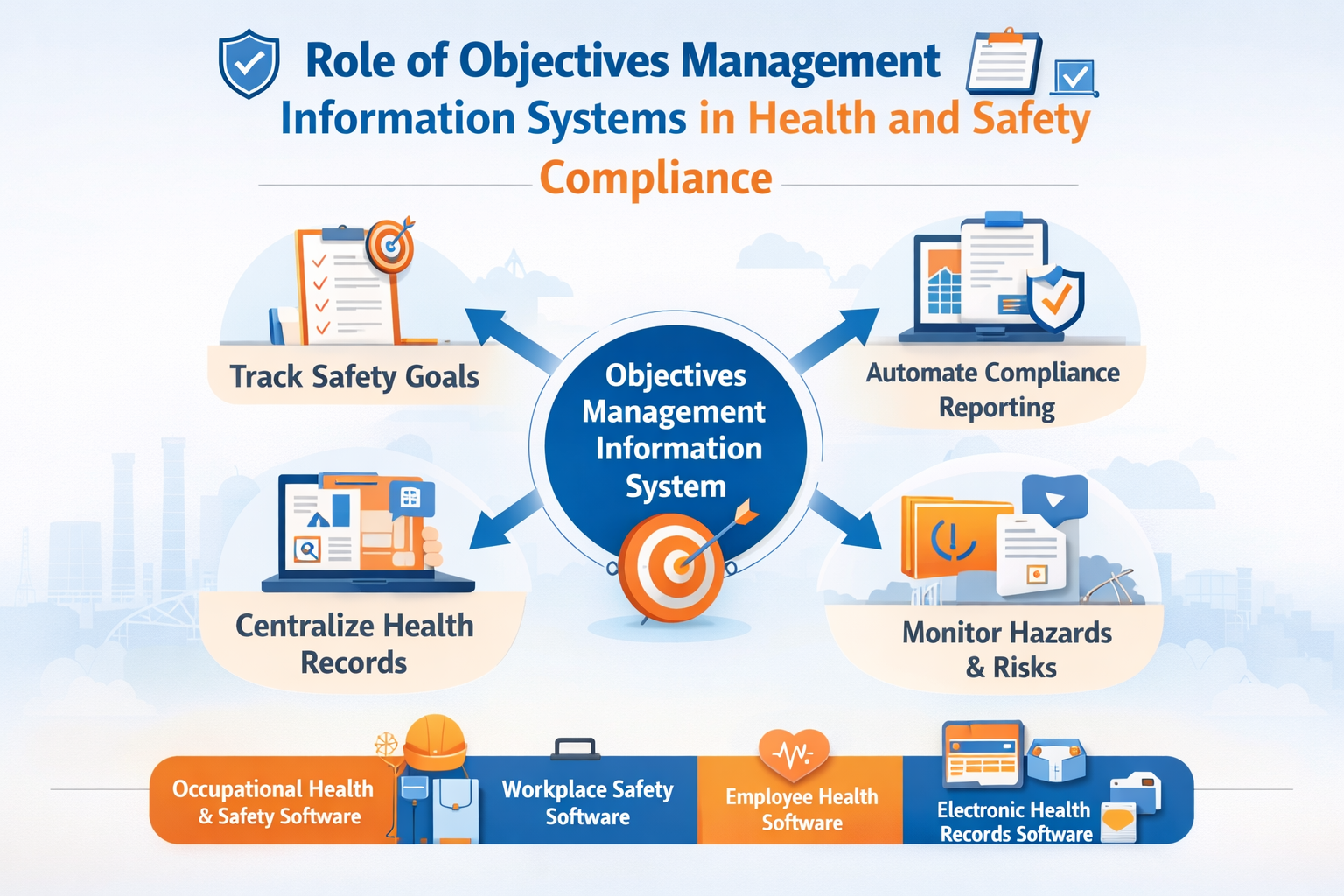
An Objectives Management Information System is a digital platform that helps organizations define, track, and evaluate strategic goals. In the context of health and safety, it enables companies to set clear safety objectives, assign responsibilities, monitor progress, and generate compliance reports in real time.
When integrated with Occupational Health & Safety Software, the system provides a comprehensive framework for managing safety programs, audits, training schedules, and corrective actions. This integration ensures that safety objectives are not only defined but also achieved effectively.
Aligning Safety Goals with Regulatory Requirements
One of the most significant roles of an Objectives Management Information System is aligning organizational safety goals with regulatory requirements. Instead of treating compliance as a reactive process, companies can:
-
Set measurable safety performance indicators
-
Define timelines for regulatory audits
-
Assign accountability to specific departments
-
Track corrective action completion rates
By linking safety objectives with compliance standards, businesses reduce the risk of non-compliance and create a culture of accountability.
Centralized Data Management for Better Visibility
Health and safety compliance requires accurate, up-to-date information. Manual systems often result in scattered data across departments. An Objectives Management Information System centralizes all compliance-related data, including:
-
Incident reports
-
Risk assessments
-
Training records
-
Audit findings
When combined with Workplace Safety Software, organizations gain complete visibility into safety performance. Managers can access dashboards that display real-time metrics, enabling quicker decision-making and proactive risk mitigation.
Enhancing Risk Identification and Control
Compliance is not just about documentation—it’s about preventing accidents and protecting employees. With digital objective tracking, companies can identify recurring risks and patterns. For example:
-
Increased incidents in specific departments
-
Repeated equipment-related injuries
-
Delayed corrective actions
By analyzing trends, organizations can refine safety objectives and implement targeted interventions. This proactive approach strengthens compliance and reduces workplace hazards.
Streamlining Documentation and Reporting
Regulatory bodies often require detailed documentation to demonstrate compliance. Preparing reports manually can be time-consuming and prone to errors. An Objectives Management Information System automates:
Integration with Electronic Health Records Software ensures that employee health data is securely stored and accessible when needed. This is particularly valuable for industries where occupational health monitoring is mandatory.
Supporting Employee Health Monitoring
Employee well-being is a core component of health and safety compliance. Modern organizations increasingly rely on Employee Health Software to monitor medical checkups, vaccination records, and occupational health screenings.
When connected with an Objectives Management Information System, health-related objectives—such as reducing workplace illnesses or increasing medical screening participation—can be tracked systematically. This ensures that health initiatives align with broader compliance goals.
Improving Accountability and Transparency
Compliance requires clear accountability. Without defined responsibilities, safety objectives may be overlooked. An Objectives Management Information System assigns ownership of tasks, deadlines, and action plans.
This transparency benefits:
-
Management teams overseeing compliance
-
Safety officers conducting inspections
-
Employees responsible for corrective measures
Automated notifications and reminders ensure that deadlines are not missed, reducing the risk of compliance failures.
Facilitating Continuous Improvement
Health and safety compliance is an ongoing process. Regulations evolve, and organizations must adapt accordingly. By continuously monitoring safety objectives, companies can:
-
Evaluate the effectiveness of safety policies
-
Identify improvement areas
-
Update procedures based on audit findings
-
Set new performance benchmarks
Integration with Occupational Health & Safety Software further enhances this process by providing analytics that guide strategic decisions.
Enhancing Training and Awareness
Employee training is a fundamental compliance requirement. An Objectives Management Information System tracks training schedules, participation rates, and completion status. When linked with Workplace Safety Software, organizations can ensure that:
-
All employees receive mandatory safety training
-
Refresher courses are conducted on time
-
Training effectiveness is evaluated
This structured approach reduces compliance gaps caused by inadequate awareness or outdated knowledge.
Reducing Legal and Financial Risks
Non-compliance can result in severe penalties and lawsuits. By implementing a digital objectives management framework, organizations minimize legal risks through:
-
Automated compliance tracking
-
Accurate documentation storage
-
Timely corrective action implementation
-
Real-time monitoring of regulatory changes
With Electronic Health Records Software integration, medical documentation is properly maintained, ensuring readiness during inspections or audits.
Building a Proactive Safety Culture
Beyond regulatory requirements, an Objectives Management Information System fosters a proactive safety culture. Employees become more engaged when safety objectives are clearly communicated and progress is visible. Regular performance reviews encourage participation and accountability.
When supported by Employee Health Software and Workplace Safety Software, the system creates an interconnected environment where health, safety, and compliance operate seamlessly.
Conclusion
The role of an Objectives Management Information System in health and safety compliance extends far beyond administrative convenience. It provides structure, accountability, automation, and strategic insight into every aspect of workplace safety management. By integrating with Occupational Health & Safety Software, Workplace Safety Software, Employee Health Software, and Electronic Health Records Software, organizations create a unified compliance ecosystem. This digital transformation not only reduces regulatory risks but also enhances employee well-being and operational efficiency. In a world where safety standards continue to evolve, adopting a comprehensive objectives management approach is no longer optional—it is essential for sustainable and compliant business growth.



 Leader Board

 Arabic
 French
 Spanish
 Portuguese
 Deutsch
 Turkish
 Dutch
Dutch
 Italiano
 Russian
 Romaian
 Portuguese (Brazil)
 Greek
Greek