


 Leader Board
Flexible Battery Market Analysis by Size, Trends & Growth Report, 2030 | UnivDatos
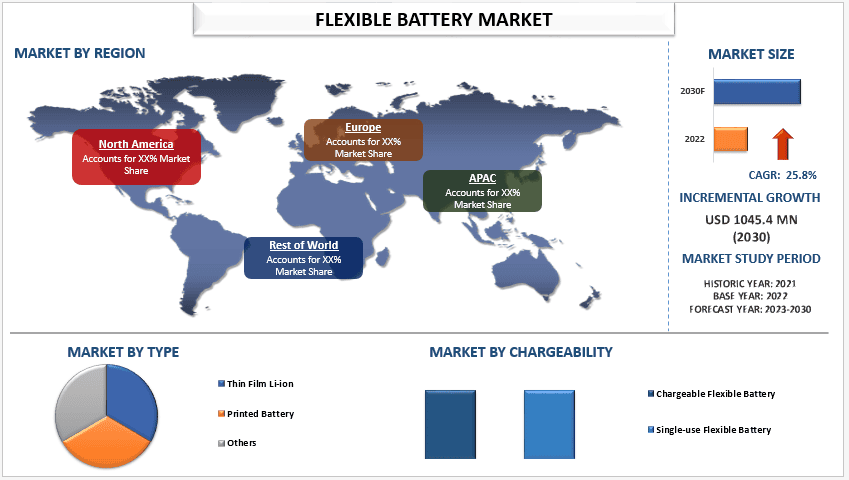
According to the UnivDatos analysis, the rising investment in smart cards and wearable electronics will drive the global scenario of the Flexible Battery market and as per their “Flexible Battery Market” report, the global market was valued at USD 165.9 Million in 2022, growing at a CAGR of 25.8% during the forecast period from 2023 - 2030 to reach USD 1,045.4 Million by 2030.
A flexible battery is a type of battery, both primary and secondary, that is designed to be conformal and flexible, unlike traditional rigid batteries. It can maintain its characteristic shape even when continuously bent or twisted. The increasing interest in portable and flexible electronics has led to the development of flexible batteries, which are used in products such as flexible and wearable electronics, novelty packaging, flexible displays, and transdermal drug delivery patches. These batteries can be fabricated into different shapes and sizes using various methods, such as using polymer binders to fabricate composite electrodes or filtering electrode suspension through filters to form free- or use flexible matrix to hold electrode materials.
Access sample report (including graphs, charts, and figures): https://univdatos.com/reports/flexible-battery-market?popup=report-enquiry
Rising Prevalence of Smart Cards in the Hospitality Industry:
Smart cards, particularly RFID and NFC hotel key cards, are increasingly being adopted in the hospitality industry. These cards allow for secure contactless access to hotel facilities and provide cashless payment options at various amenities within the hotel or resort. The shift towards contactless payment methods, including the use of smart cards, has been accelerated by the COVID-19 pandemic and the changing expectations of customers. Contactless payments are popular due to their convenience, speed, and enhanced security features, which encrypt credit card information, making it difficult for fraudsters to steal any information. In addition to smart cards, virtual cards for hotel stays are also on the rise, simplifying back-office finance administration and providing better control over travel spend.
Flexible batteries are designed to be conformal and flexible, unlike traditional rigid ones. They can maintain their shape even against continual bending or twisting, making them ideal for use in smart cards, wearables, and IoT devices. For example, Panasonic has developed highly flexible lithium-ion batteries that can withstand repeated bending and twisting, with a height of only 0.55 millimeters, making them suitable for smart cards and wearable devices. The increasing interest in portable and flexible electronics has led to the development of flexible batteries, which can be implemented in products such as smart cards, wearable electronics, novelty packaging, flexible displays, and transdermal drug delivery patches.
Click here to view the Report Description & TOC https://univdatos.com/reports/flexible-battery-market
Rising Lithium Prices are effecting the Flexible Battery Market
Historic price peaks and extreme volatility, as well as quickly changing national regulations, can massively affect the economic viability of projects. Higher battery prices for flexible batteries also make them far less attractive than they were previously, which could delay much-needed attempts to accelerate market growth. Although economic viability is the most urgent issue for companies, a more complex challenge involves the industrialization and historic scale-up of the battery industry.
Conclusion
In conclusion, the Flexible Battery market is poised for significant growth. The increasing demand for smart cards, consumer wearable electronics and various applications in defence sector are key factors driving this growth.
Flexible battery technologies are on the cusp of revolutionizing the electronics industry, and they have a wide range of applications, including wearable electronics, medical devices, and foldable electronics. The advantages of flexible batteries are their conformability, lightweight, and portability, which makes them easy to be implemented in products such as flexible and wearable electronics. However, there are still challenges to overcome, such as improving the energy density of flexible batteries and ensuring their mechanical durability and electrochemical stability. Despite these challenges, the development of flexible batteries with high energy density and good flexibility is considered a major breakthrough in the field of energy storage.
Contact Us:
UnivDatos
Contact Number - +1 978 733 0253
Email - contact@univdatos.com
Website - www.univdatos.com
Linkedin- https://www.linkedin.com/company/univ-datos-market-insight/mycompany/

 English
 Arabic
 French
 Spanish
 Portuguese
 Turkish
 Dutch
Dutch
 Italiano
 Russian
 Romaian
 Portuguese (Brazil)
 Greek
Greek