


 Leader Board
Can Flight Scheduling Software Transform Airline Operations and Boost Efficiency in a Rapidly Growing Aviation Market?

The aviation industry has always been at the forefront of technological innovation, constantly seeking ways to improve efficiency, reduce costs, and enhance passenger experience. As air travel demand continues to soar globally, the need for advanced digital tools in airline operations becomes increasingly critical. One such innovation at the heart of operational efficiency is flight scheduling software. But how transformative can these systems really be? Can they effectively streamline airline operations, reduce delays, and optimize resources in an ever-growing and complex aviation market? Let’s explore these questions in depth.
What Is Flight Scheduling Software and Why Is It Important?
Flight scheduling software is a digital platform designed to automate and optimize airline operations, particularly flight and crew scheduling. Airlines face a highly complex ecosystem where factors such as aircraft availability, crew shifts, maintenance requirements, airport slot restrictions, and passenger demand all interact. Traditional manual scheduling methods are no longer sufficient.
Why is scheduling crucial in aviation?
Scheduling directly impacts:
- Operational efficiency: Efficient schedules ensure aircraft and crew are fully utilized without unnecessary downtime.
- Punctuality: Optimized schedules reduce flight delays, improving passenger satisfaction.
- Safety compliance: Scheduling software ensures adherence to strict regulatory standards governing crew working hours, maintenance cycles, and air traffic rules.
- Cost reduction: Automation minimizes manual errors and overstaffing, cutting operational costs significantly.
Given these benefits, it is unsurprising that the Flight Scheduling Software Market was valued at USD 725.6 million in 2024 and is projected to reach USD 1,510.7 million by 2032, growing at a CAGR of 9.6%. But what is driving this surge in adoption?
What Are the Key Drivers Behind the Growth of Flight Scheduling Software?
Several forces are fueling the rapid adoption of flight scheduling software across the globe.
1. Rising Air Traffic
Global air traffic is increasing steadily, particularly in Asia-Pacific, where countries like China, India, and Southeast Asia are witnessing a surge in domestic and international flights. More flights mean more complexity in scheduling, creating a pressing need for automated systems that can handle thousands of variables in real-time.
2. Need for Operational Efficiency
Airlines are under constant pressure to reduce operational costs while maintaining punctuality and reliability. Flight scheduling software allows airlines to allocate crew and aircraft efficiently, optimize turnaround times, and minimize disruptions due to unexpected delays.
3. Safety and Regulatory Compliance
Aviation regulators enforce strict guidelines for crew working hours, aircraft maintenance, and operational safety. Manual scheduling is prone to errors, which can lead to non-compliance and fines. Modern software ensures automatic adherence to regulatory standards, mitigating risks.
4. Real-Time Coordination and Predictive Analytics
Advanced platforms now incorporate AI-driven analytics, cloud-based deployment, and IoT-enabled tools, allowing airlines to predict disruptions, manage delays proactively, and adjust schedules dynamically. This real-time capability ensures better passenger experience and resource utilization.
How Are Different Regions Adopting Flight Scheduling Software?
The global adoption of flight scheduling software varies by region, influenced by infrastructure, regulatory frameworks, and airline priorities.
North America: Leading Digital Adoption
North America remains the leader in digital scheduling solutions due to advanced aviation infrastructure and the early adoption of cloud-based platforms. Major airlines like Delta and American Airlines have integrated AI-powered systems to optimize crew allocation and flight operations.
Europe: Emphasis on Compliance and Sustainability
European airlines focus on sustainable operations and regulatory compliance, utilizing flight scheduling software to minimize delays, reduce fuel consumption, and adhere to environmental standards. Cloud-based systems also help airlines respond flexibly to disruptions in a highly regulated airspace.
Asia-Pacific: Rapid Market Expansion
The Asia-Pacific region is witnessing rapid growth in air traffic and investments in smart airport projects. Airlines in China, India, and Southeast Asia are increasingly digitizing operations, leveraging scheduling software to manage complex networks and ensure punctuality.
Latin America and Middle East & Africa: Gradual Adoption
These regions are gradually embracing flight scheduling solutions, driven by infrastructure modernization and growing airline networks. The integration of predictive analytics and cloud platforms is helping carriers enhance efficiency and improve service quality.
Who Are the Key Players in the Flight Scheduling Software Market?
The market is highly competitive, with leading technology and aviation companies investing heavily in innovation. Major players include:
- Amadeus IT Group: Offers AI-driven scheduling and resource optimization for airlines worldwide.
- Lufthansa Systems: Focuses on cloud-based platforms and predictive analytics to improve operational efficiency.
- Sabre Corporation: Provides comprehensive software suites for crew and flight scheduling.
- IBS Software: Integrates automation and real-time data to support complex airline operations.
- GE Aviation: Enhances scheduling solutions with predictive maintenance and IoT-enabled insights.
These companies strengthen competitiveness by forming strategic partnerships, adopting cloud-based platforms, and integrating AI for predictive insights.
What Are the Emerging Trends in Flight Scheduling Software?
Several trends are shaping the future of the market:
1. AI and Machine Learning Integration
AI helps in predicting flight disruptions, optimizing crew schedules, and improving aircraft utilization, significantly reducing delays and operational costs. Machine learning algorithms also continuously refine schedules based on historical data and real-time updates.
2. Cloud-Based Deployment
Cloud platforms allow airlines to access scheduling software anywhere, anytime, enabling collaboration across multiple locations and reducing dependency on legacy systems.
3. IoT and Predictive Insights
IoT-enabled devices on aircraft and airport infrastructure provide real-time data for predictive analytics, allowing proactive management of delays, maintenance requirements, and passenger flow.
4. Focus on Passenger Experience
Modern scheduling systems contribute to better passenger experience by minimizing flight disruptions, ensuring timely arrivals, and providing real-time updates.
What Are the Challenges Limiting Market Growth?
Despite the clear advantages, some challenges persist:
- High implementation costs: Advanced systems can be expensive, particularly for small and mid-sized carriers.
- Integration complexities: Legacy IT systems may not easily integrate with modern scheduling platforms, requiring significant technical adjustments.
- Data security concerns: Cloud-based systems and real-time analytics require robust cybersecurity measures to protect sensitive operational data.
These challenges, however, are gradually being addressed as technology becomes more scalable, affordable, and secure.
How Can Airlines Leverage Flight Scheduling Software for Maximum Impact?
To fully harness the potential of flight scheduling software, airlines must:
- Invest in AI-driven and cloud-based platforms for real-time scheduling and predictive analytics.
- Train staff and integrate systems to ensure seamless adoption and operational efficiency.
- Collaborate with leading technology providers to customize solutions for their unique network and operational requirements.
- Prioritize data security to safeguard sensitive operational information.
- Continuously monitor and optimize schedules using analytics, historical data, and predictive models.
By doing so, airlines can reduce delays, optimize resource utilization, comply with regulations, and deliver superior passenger experiences.
What Does the Future Hold for the Flight Scheduling Software Market?
The outlook for the market remains highly positive. With airlines prioritizing digital transformation, cost reduction, and improved passenger experiences, the adoption of flight scheduling software is expected to accelerate globally.
- The market size is projected to reach USD 1,510.7 million by 2032, reflecting a nearly doubling of value within eight years.
- Regions like Asia-Pacific will continue to drive growth due to rising air traffic and infrastructure investments.
- Innovations such as AI, IoT, and predictive analytics will become standard components of scheduling platforms.
In essence, the future of flight scheduling software is intertwined with the broader digital evolution of the aviation industry. Airlines that embrace these technologies will likely gain competitive advantages, reduce operational risks, and enhance customer satisfaction.
How Flight Scheduling Software Is Driving Efficiency, Compliance, and Innovation in the Aviation Industry
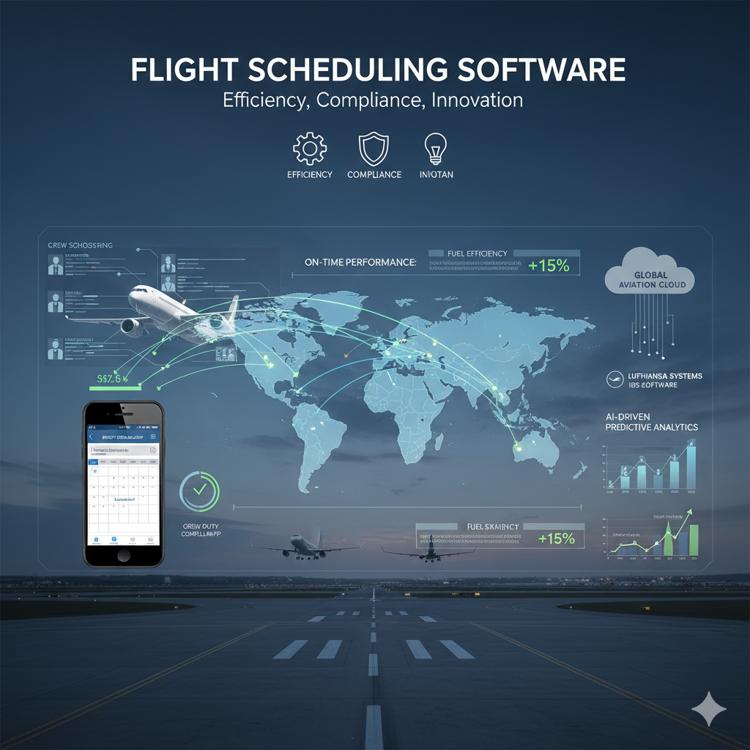
The aviation sector operates in one of the most complex and high-stakes environments in the world. Airlines must balance operational efficiency, regulatory compliance, passenger satisfaction, and environmental sustainability—all while managing increasingly complex networks of aircraft and crew. In this landscape, flight scheduling software has emerged as a critical tool for airlines seeking to modernize operations, optimize resources, and improve overall performance.
From cloud-based platforms to AI-driven predictive analytics, these systems are reshaping how airlines plan flights, allocate crews, and respond to disruptions. This article explores the key market drivers, trends, and real-world implementations that highlight the transformative impact of flight scheduling software on modern aviation.
Rising Demand for Operational Efficiency in Airlines
Airlines worldwide face rising passenger traffic and increasingly complex route networks. Manual scheduling processes are no longer sufficient to handle the operational demands of modern aviation. Flight scheduling software allows carriers to automate complex operations, including aircraft utilization, crew allocation, and turnaround time optimization.
Key benefits include:
- Improved operational visibility: Airlines can monitor flights, crews, and resources in real time.
- Reduced delays: Real-time scheduling reduces bottlenecks and improves on-time performance.
- Fuel efficiency: Optimized routing and aircraft utilization help reduce unnecessary fuel consumption, lowering operational costs.
- Cost control: Automation minimizes human errors and resource mismanagement, reducing operational expenditure.
Real-World Example
In January 2025, Air Canada implemented Lufthansa Systems’ NetLine/Ops ++, migrating operations to the Global Aviation Cloud. This platform supports real-time decision-making across a multicloud environment, enhancing operational efficiency and providing the airline with an integrated view of crew, aircraft, and scheduling needs.
Adoption of Cloud-Based and Digital Solutions
Cloud technology is rapidly transforming the Flight Scheduling Software Market. Airlines are moving from on-premise systems to cloud-based platforms due to their scalability, cost efficiency, and ability to integrate seamlessly across operations.
Benefits of cloud deployment include:
- Collaboration: Stakeholders such as crew, ground staff, and operations managers can access schedules in real time.
- Flexibility: Airlines can quickly adapt to changes in passenger demand or operational disruptions.
- Resilience: Cloud platforms enable rapid response during flight delays or cancellations.
- Cost savings: Reduced IT infrastructure costs and easier maintenance contribute to lower operational expenses.
Real-World Example
In May 2025, Air France-KLM partnered with IBS Software to integrate the iFlight platform across a fleet of over 500 aircraft. This deployment allows real-time crew and schedule optimization, significantly reducing delays and enhancing operational efficiency.
Compliance with Aviation Regulations and Standards
Strict aviation regulations drive the adoption of flight scheduling software. Airlines must comply with rules covering:
- Crew duty hours and rest periods
- Aircraft maintenance schedules
- Flight safety standards
Automated scheduling systems ensure compliance by automatically checking and enforcing regulatory requirements, reducing the risk of penalties, flight cancellations, or operational disruptions. Governments and aviation authorities increasingly emphasize the use of digital tools to improve safety, accountability, and operational transparency.
Enhancing Passenger Experience and Service Quality
Passenger expectations for reliability and seamless travel are higher than ever. Flight scheduling software contributes to:
- Minimizing delays: Optimized schedules reduce flight disruptions and missed connections.
- Efficient resource management: Proper allocation of aircraft and crew ensures smoother operations.
- Data-driven decision making: Airlines can align flight capacity with real-time demand trends, improving service quality.
- Customer loyalty: On-time performance and smooth travel experiences enhance passenger satisfaction.
Airlines that implement advanced scheduling tools are better positioned to meet passenger expectations and maintain competitive advantage in a crowded marketplace.
Integration of Artificial Intelligence and Machine Learning
A major trend in the Flight Scheduling Software Market is the integration of AI and machine learning. These technologies enable airlines to:
- Predict flight disruptions and recommend optimal rescheduling options
- Support predictive maintenance by analyzing aircraft usage and operational data
- Improve route planning and fuel efficiency through real-time analytics
By shifting from reactive to predictive scheduling, airlines can minimize costs and operational risks, making smarter, data-driven decisions.
Real-World Example
In December 2024, GE Aerospace integrated Aireon’s space-based ADS-B data into its Airspace Insight platform. This provides global, real-time aircraft tracking, enhancing AI-driven predictions for operational optimization.
Expansion of Cloud-Based and Mobile Platforms
Cloud adoption in aviation is expanding beyond desktop scheduling platforms. Mobile solutions now allow crew members and ground staff to access real-time schedules on their devices, facilitating faster communication and operational flexibility.
Benefits include:
- Centralized decision-making
- Optimized resource utilization
- Faster response to disruptions
- Improved crew collaboration and efficiency
Real-World Example
Air France-KLM’s iFlight cloud-native solution, launched in May 2025, allows crew members to view schedules, duty information, and other resources via the iFlight Crew Mobile Application, ensuring seamless operational coordination.
Adoption of Data Analytics for Operational Insights
Data analytics is playing an increasingly critical role in flight scheduling. Airlines use advanced analytics tools to process large datasets, including:
- Passenger demand patterns
- Weather conditions
- Air traffic trends
Analytics-driven scheduling enables airlines to allocate resources efficiently, reduce overcapacity, and optimize fleet utilization. Scenario modeling and predictive insights also improve resilience during peak travel periods, ensuring smoother operations.
Focus on Sustainability and Fuel Efficiency
Sustainability is a growing priority in aviation, and flight scheduling software supports eco-friendly operations through:
- Route optimization: Minimizing unnecessary mileage and fuel consumption
- Aircraft utilization: Reducing idle time and maximizing operational efficiency
- Carbon footprint reduction: Aligning with regulatory requirements and consumer expectations for greener travel
By integrating sustainability features, scheduling systems help airlines meet environmental targets while improving operational efficiency.
Flight Scheduling Software Market: Challenges, Opportunities, and Regional Insights
The aviation industry is experiencing rapid transformation, driven by increasing passenger traffic, expanding airline networks, and evolving regulatory frameworks. At the center of this evolution is flight scheduling software, a critical tool that enables airlines to optimize operations, improve efficiency, and enhance passenger experience.
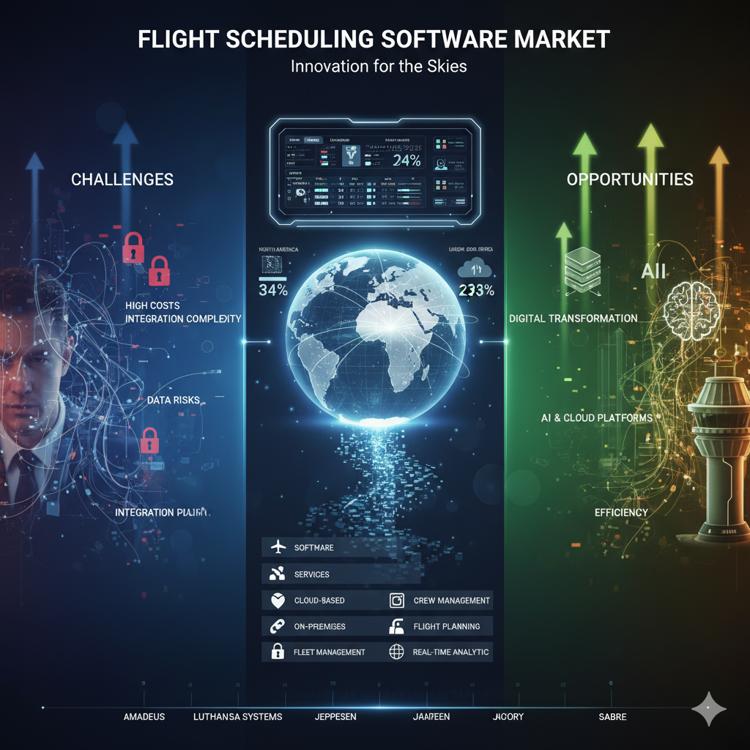
While the market offers significant benefits, it also faces challenges such as high implementation costs, data security risks, and integration complexities. At the same time, rising digital adoption, AI integration, and cloud platforms provide immense opportunities. This article provides a comprehensive, list-based overview of the Flight Scheduling Software Market, including market challenges, opportunities, segmentation, regional analysis, and key players.
1. Market Challenges
1.1 High Implementation Costs and Integration Complexities
- Airlines often face high upfront costs for licensing, software customization, and employee training.
- Small and mid-sized carriers struggle to justify the financial investment, creating barriers to adoption.
- Integration with legacy systems requires specialized technical expertise and time, delaying deployment.
- Implementation delays can temporarily disrupt operations, reducing expected efficiency gains.
- These cost and integration barriers slow large-scale adoption across the aviation sector.
1.2 Data Security Risks and Limited Skilled Workforce
- Cloud-based and digital platforms expose sensitive operational and passenger data to cyber threats.
- Compliance with aviation and global data protection regulations is critical and adds complexity.
- Airlines often lack skilled personnel capable of managing AI-driven analytics and predictive modeling features.
- Continuous training increases operating costs while highlighting the need for specialized talent.
- These factors limit the full utilization of advanced scheduling solutions.
2. Market Opportunities
2.1 Rising Demand for Digital Transformation in Aviation
- Airlines increasingly prioritize automation to optimize crew assignments and manage irregular operations.
- Real-time coordination between ground staff, pilots, and air traffic controllers reduces delays and improves customer satisfaction.
- Government-backed modernization programs promote adoption of advanced scheduling systems.
- Low-cost carriers and regional operators benefit from streamlined scheduling, improving resource utilization.
- The growing reliance on digital platforms positions flight scheduling software as a core operational tool worldwide.
2.2 Integration of AI, Predictive Analytics, and Cloud Platforms
- AI-driven scheduling tools forecast passenger demand, predict operational disruptions, and recommend optimized routes.
- Predictive maintenance features integrate aircraft health data to reduce downtime and operational risks.
- Cloud-based platforms offer scalable, cost-efficient solutions, improving flexibility across global operations.
- Collaborations between software providers and airlines enhance customized solutions tailored to operational needs.
- Expansion of smart airports and digital aviation ecosystems strengthens the long-term role of scheduling software.
3. Market Segmentation Analysis
3.1 By Component
- Software: Holds the largest market share; automates flight planning, resource allocation, and real-time monitoring.
- Services: Include consulting, customization, training, and managed services to ensure smooth implementation.
Example: In August 2025, China Airlines adopted Lufthansa Systems’ NetLine/Plan software to manage over 80 aircraft and 140 global destinations.
3.2 By Deployment Model
- Cloud-based Solutions: Offer scalability, accessibility, and cost-effective deployment; enable real-time access and global collaboration.
- On-premises Solutions: Preferred by airlines with strict regulatory or security requirements; provide greater control and customization but incur higher maintenance costs.
3.3 By Functionality
- Crew Management: Ensures efficient scheduling, regulatory compliance, and resource optimization.
- Flight Planning: Optimizes routes, reduces fuel consumption, and improves on-time performance.
- Fleet Management: Supports aircraft utilization, maintenance scheduling, and cost reduction.
- Real-Time Analytics: Provides data-driven insights for predictive decision-making.
Example: Jeppesen’s FliteDeck Advisor, used by Virgin Atlantic, delivered 1.7% cruise fuel savings through optimized flight planning.
3.4 By End-User
- Airlines
- Airports
- Logistics & Cargo Companies
- Military & Defense
- Flight Schools & Training Centers
4. Regional Analysis
4.1 North America
- Holds the largest market share (34%) in 2024.
- Growth driven by advanced aviation infrastructure, digital adoption, and regulatory compliance.
- U.S.: Demand from commercial carriers, regional airlines, and charter operators.
- Canada: Investments in fleet digitization and smart airports.
- Mexico: Expansion of low-cost carriers and cross-border aviation activities.
4.2 Europe
- Represents 29% of the market in 2024.
- Adoption focused on sustainability, compliance, and modernization.
- Leading countries: Germany, France, United Kingdom.
- EASA regulations ensure adherence to strict standards for crew management and operational efficiency.
- Eastern Europe shows gradual growth through modernization programs.
4.3 Asia-Pacific
- Accounts for 23% of the market, with the fastest growth rate.
- China: Expanding aviation industry, new airports, government modernization programs.
- India: Rising demand from low-cost carriers and regional connectivity initiatives.
- Japan & South Korea: Adoption of advanced scheduling tools for fleet and crew management.
- Southeast Asia: Steady adoption driven by tourism and air cargo growth.
4.4 Latin America
- Holds an 8% share in 2024.
- Brazil & Mexico: Strong airline networks, regional connectivity, and low-cost carrier growth.
- Other contributors: Argentina, Chile, Colombia.
- Challenges: Budget constraints and slower digital adoption in smaller markets.
4.5 Middle East & Africa
- Accounts for 6% share in 2024.
- Gulf countries (UAE, Saudi Arabia, Qatar) invest in aviation hubs and smart airports.
- Africa adoption slower due to limited budgets and infrastructure gaps, but countries like South Africa and Nigeria are modernizing.
- Government diversification strategies and tourism growth create opportunities for adoption.
5. Key Players in the Market
- Amadeus IT Group
- FLYHT Aerospace Solutions Ltd.
- Lufthansa Systems
- Jeppesen (Boeing subsidiary)
- IBS Software
- Airline Software Applications
- GE Aviation
- AIMS International
- Sabre Corporation
These companies drive innovation through AI integration, predictive analytics, cloud deployment, and partnerships with airlines worldwide.
6. Summary
Challenges:
- High implementation and integration costs
- Data security risks and limited skilled workforce
- Slower adoption among small and mid-sized carriers
Opportunities:
- Rising demand for digital transformation and automation
- AI, predictive analytics, and cloud-based platforms
- Government-backed modernization initiatives and smart airport projects
Segmentation Highlights:
- Software dominates over services
- Cloud deployment growing faster than on-premises
- Crew management is the largest functionality segment
Regional Insights:
- North America leads with 34% share
- Europe follows with 29%, emphasizing sustainability and compliance
- Asia-Pacific records fastest growth at 23%
- Latin America and Middle East & Africa gradually expand adoption
The Flight Scheduling Software Market is positioned for strong global growth, driven by increasing operational complexity, digital transformation initiatives, and technological innovation. Airlines and aviation stakeholders that adopt advanced scheduling solutions can achieve higher efficiency, compliance, sustainability, and customer satisfaction, positioning themselves as leaders in the rapidly evolving aviation landscape.
Source: https://www.credenceresearch.com/report/flight-scheduling-software-market
Who’s Leading the Flight Scheduling Software Market and What’s Driving Their Success?
As the aviation industry evolves rapidly, airlines are increasingly relying on advanced flight scheduling software to optimize operations, reduce costs, and enhance passenger experiences. But who are the key players shaping this market, and what strategies are enabling their success? How are technological innovations, partnerships, and digital transformation trends driving adoption across the globe? This article explores these questions and provides a deep dive into the competitive landscape, recent developments, and future outlook of the Flight Scheduling Software Market.
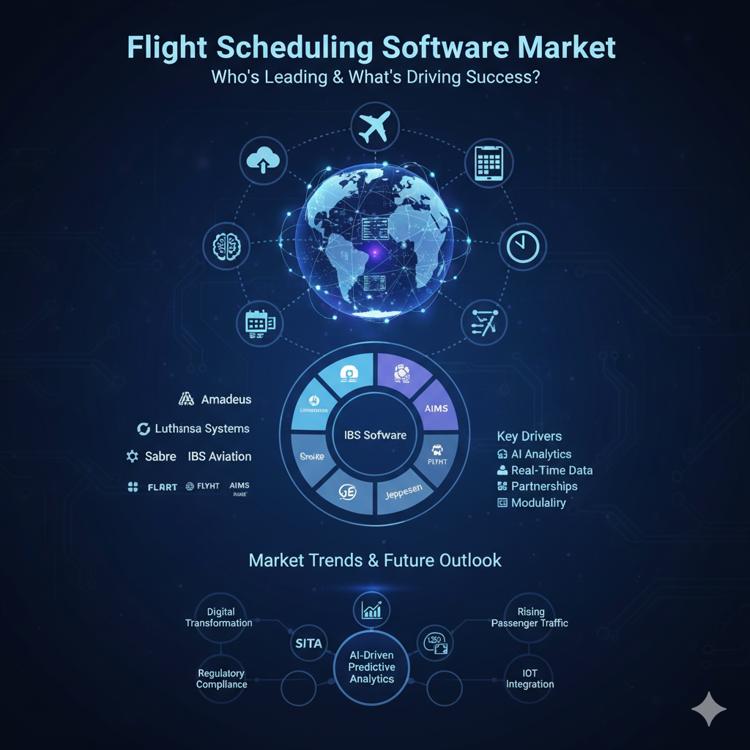
Who Are the Key Players in the Flight Scheduling Software Market?
The market features highly competitive players that offer end-to-end solutions for airlines, airports, and other aviation stakeholders.
- Amadeus IT Group: Focuses on AI-driven analytics, cloud-based solutions, and real-time operational platforms.
- Lufthansa Systems: Provides solutions for strategic network planning, crew management, and predictive analytics.
- Sabre Corporation: Offers comprehensive airline software platforms with scheduling, revenue management, and flight planning modules.
- IBS Software: Integrates cloud-based scheduling and crew optimization with scalable deployment options.
- GE Aviation: Enhances flight planning with predictive maintenance and IoT-enabled insights.
- Jeppesen (Boeing subsidiary): Specializes in flight optimization and fuel-saving solutions.
- SITA, FLYHT Aerospace Solutions Ltd., Airline Software Applications, AIMS International: Provide niche platforms and specialized scheduling solutions for both commercial and regional airlines.
Why Are These Players Dominating the Market?
These companies lead by providing advanced, integrated platforms that:
- Optimize flight planning and crew scheduling
- Ensure regulatory compliance and safety
- Incorporate AI-driven analytics for predictive operations
- Utilize cloud-based deployment for scalability and flexibility
- Offer real-time data insights to minimize delays
- Support end-to-end digital ecosystems, including passenger services, predictive maintenance, and operational modules
The competitive pressure drives continuous innovation, ensuring airlines gain efficiency, improve passenger satisfaction, and maintain compliance with evolving aviation regulations.
How Are Partnerships and Strategic Alliances Shaping the Market?
Strategic collaborations are a key driver of market growth. Partnerships allow software providers to expand their global presence, integrate new technologies, and offer customized solutions for airlines of all sizes.
Recent Examples:
- China Airlines (August 2025): Adopted Lufthansa Systems’ NetLine/Plan network-planning solution to enhance strategic scheduling.
- Amadeus & Google (July 2025): Integrated Google’s QPX flight-management system and Google Flights into Amadeus’ platform, enhancing scheduling and flight-search capabilities.
- ANA (All Nippon Airways, July 2025): Selected Lido Flight 4D for next-generation flight planning to improve operational efficiency.
- FLYHT & MBS Electronic Systems (May 2024): Developed a prototype for a secure wireless avionics software vault and onboard data-loading, boosting in-flight compliance and safety.
These examples illustrate how alliances and technology integration strengthen software offerings, making them more appealing to both full-service and low-cost carriers.
How Does Technological Innovation Drive Competitive Advantage?
In an increasingly digital aviation ecosystem, airlines demand solutions that improve operational efficiency, reduce costs, and enhance decision-making. Market leaders focus on several key innovations:
1. AI-Driven Predictive Analytics
- Forecast flight disruptions, crew availability, and passenger demand.
- Optimize routes and improve fuel efficiency.
- Enable predictive maintenance to reduce downtime and operational risks.
2. Cloud-Based Deployment
- Provides scalable, cost-efficient solutions.
- Facilitates real-time access across multiple locations and devices.
- Enables collaboration between airlines, ground staff, and operations centers.
3. IoT and Real-Time Data Platforms
- Integrates aircraft telemetry and operational data.
- Supports dynamic scheduling and route optimization.
- Improves flight planning efficiency and resilience against disruptions.
4. Modular Scheduling Tools
- Crew scheduling, fleet management, and resource optimization modules allow tailored solutions for different airline types.
- Low-cost carriers and regional airlines can adopt flexible, scalable platforms that align with local operational requirements.
What Are the Market Trends Influencing Adoption?
Several trends are shaping the Flight Scheduling Software Market today:
- Digital Transformation in Airline Operations: Airlines increasingly prioritize automation for crew scheduling, irregular operations management, and on-time performance.
- Rising Passenger Traffic: Greater passenger volumes drive demand for automated scheduling solutions to reduce delays and improve reliability.
- Cloud-Based Scalability: Cloud adoption accelerates due to lower infrastructure costs and real-time collaboration benefits.
- Regulatory Compliance & Safety Standards: Evolving aviation regulations continue to influence software development.
- End-to-End Digital Ecosystems: Software platforms now integrate scheduling, passenger services, predictive maintenance, and analytics into a single solution.
What Are the Competitive Advantages of Leading Players?
Market leaders differentiate themselves by focusing on three core areas:
- Innovation & R&D Investment
- Continuous development of user-friendly, AI-enabled platforms
- Integration of predictive analytics and IoT for real-time decision-making
- Strategic Partnerships
- Collaborations with airlines, aviation authorities, and technology providers
- Global reach expansion and integration with complementary systems
- End-to-End Digital Solutions
- Full-service platforms covering crew scheduling, flight planning, maintenance, and passenger services
- Modular solutions tailored to full-service, low-cost, and regional carriers
By focusing on these areas, leading players maintain relevance in a highly competitive and rapidly evolving market.
How Will the Flight Scheduling Software Market Evolve?
The future outlook for the market indicates strong growth driven by several key factors:
- Rising Demand for Digital Transformation: Airlines are investing heavily in software to automate scheduling and improve operational efficiency.
- Cloud Adoption: Scalable and cost-effective cloud solutions will gain broader traction.
- AI-Driven Analytics: Enhanced predictive capabilities will improve operational accuracy.
- IoT & Real-Time Data Integration: Dynamic flight planning and real-time scheduling will become standard.
- Increased Adoption by Low-Cost Carriers: Streamlined operations and cost optimization will drive uptake.
- Partnerships & Alliances: Collaboration between software providers and airlines will accelerate innovation.
- Regulatory Compliance: Compliance and safety requirements will continue to shape software design and functionality.
What Insights Does the Market Report Offer?
The research report provides a comprehensive analysis of the market:
- Components: Software and services, highlighting adoption patterns and innovation trends.
- Deployment Models: On-premises vs. cloud-based solutions and their respective advantages.
- Functionality: Crew management, flight planning, fleet management, real-time analytics, and modular offerings.
- End-Users: Airlines, airports, logistics & cargo companies, military & defense, flight schools.
- Geography: Detailed regional analysis covering North America, Europe, Asia-Pacific, Latin America, and Middle East & Africa.
- Competitive Landscape: Overview of leading players, product offerings, investments, revenue streams, and strategic initiatives.
- Trends & Opportunities: Technological advancements, digital transformation, AI integration, and cloud adoption.
- Market Dynamics: Drivers, constraints, and regulatory impact shaping adoption.
Conclusion:
The Flight Scheduling Software Market is experiencing significant growth, with projections indicating an increase from USD 725.6 million in 2024 to USD 1,510.7 million by 2032, reflecting a compound annual growth rate (CAGR) of 9.6% . This expansion is driven by the aviation industry's increasing demand for operational efficiency, safety, and real-time coordination. Airlines are increasingly adopting advanced platforms to optimize crew allocation, reduce delays, and ensure compliance with stringent regulatory standards.
The market's growth is also supported by the rising air traffic, where automation ensures optimal resource utilization and punctuality. Key regions contributing to this growth include North America, Europe, Asia-Pacific, Latin America, and the Middle East & Africa. North America leads with advanced aviation infrastructure and early adoption of digital scheduling solutions by major airlines. Europe emphasizes sustainability, regulatory compliance, and efficient operations, supported by widespread use of cloud-based platforms. Asia-Pacific records rapid growth due to rising air traffic, smart airport projects, and increasing investments in airline digitization across China, India, and Southeast Asia. Latin America and the Middle East & Africa are gradually expanding adoption, driven by infrastructure modernization and growing airline networks.
Leading players in the market, such as Amadeus IT Group, Lufthansa Systems, Sabre Corporation, and IBS Software, are enhancing competitiveness by integrating artificial intelligence (AI), predictive analytics, and cloud capabilities into their scheduling platforms. Their focus on innovation and strategic partnerships positions them to address the evolving demands of global airline operations.
The Flight Scheduling Software Market is poised for substantial growth, driven by technological advancements and the aviation industry's need for enhanced operational efficiency and compliance. The ongoing digital transformation and strategic collaborations among key industry players are expected to further propel the market's expansion in the coming years.
Source: https://www.credenceresearch.com/report/flight-scheduling-software-market

 English
 Arabic
 French
 Spanish
 Portuguese
 Deutsch
 Turkish
 Dutch
Dutch
 Italiano
 Russian
 Romaian
 Greek
Greek