


 Leader Board
“What’s driving the surge in the low-powered electric motorcycle and scooter market?”
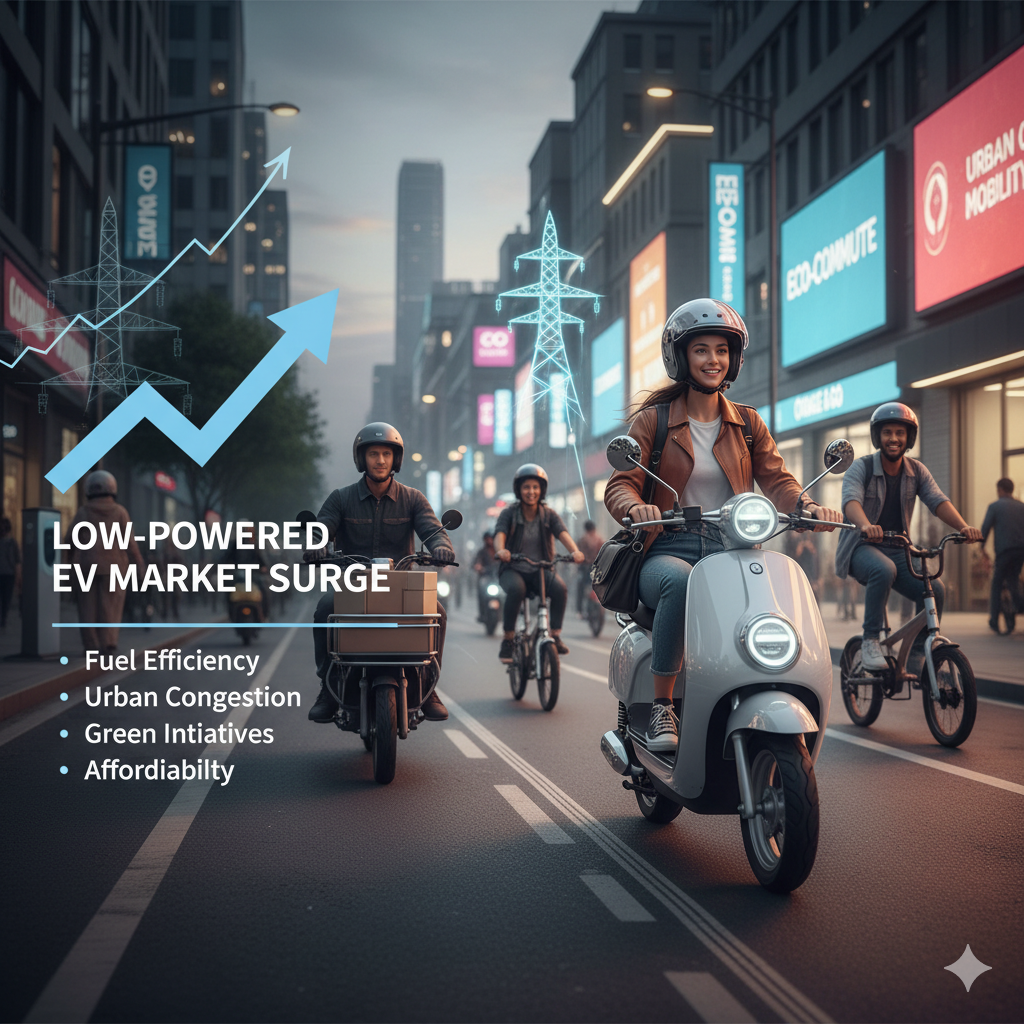
Introduction
In recent years, mobility around the world has been undergoing a transformation. Urban congestion, environmental concerns, rising fuel and maintenance costs for conventional internal-combustion vehicles — all of these are pushing users and fleets to look for smarter alternatives. Among these, the segment of low-powered electric motorcycles and scooters is seeing particularly strong growth. According to a recent report by Credence Research, Inc., the global market for low-powered electric motorcycles and scooters was valued at USD 15.14 billion in 2024, and is projected to reach USD 33.64 billion by 2032, growing at a compound annual growth rate (CAGR) of 10.5% over the forecast period. Credence Research Inc.
This prompts the key question: what’s driving this surge? And, conversely, what obstacles remain in the way of full-scale adoption? In this article we will explore the market dynamics, key drivers, segments, regional differences, challenges, and future outlook for the low-powered electric two-wheeler market.
Source-https://www.credenceresearch.com/report/low-powered-electric-motorcycle-and-scooter-market
What is the “low-powered electric motorcycle and scooter” market?
Before diving into the drivers and trends, it’s helpful to clarify what we mean by “low-powered” in this context. The report defines the market by multiple criteria: product type (electric motorcycles vs electric scooters), battery type (lithium-ion, lead-acid, NiMH) and speed segment (up to 25 km/h; 25 to 50 km/h; 50 to 70 km/h). Credence Research Inc.
Thus, “low-powered” refers less to a formal standard and more to vehicles designed for urban / peri-urban mobility, often with modest top speeds, lighter weights, shorter ranges — and typically lower cost of ownership compared with full-scale electric motorcycles or conventional petrol motorcycles. These vehicles tend to be used for short-distance commuting, delivery fleets, last-mile logistics, and in dense urban settings where high speed or long highway rides are less critical.
Key Market Figures & Growth Outlook
As mentioned above:
- Market size in 2024: USD 15.14 billion. Credence Research Inc.
- Forecast size by 2032: USD 33.64 billion. Credence Research Inc.
- Projected CAGR (2025-2032): 10.5%. Credence Research Inc.
These figures illustrate that the market is expected to more than double in about eight years. That level of growth suggests a significant shift — not just incremental — in mobility behaviour, fleet economics, and infrastructure.
What’s driving the growth?
Several key drivers underpin this growth trajectory:
1. Urban congestion, fuel-cost sensitivity and affordability
With increasing urbanisation worldwide, many cities are seeing growing traffic density, limited parking, tighter emission control and higher operational costs for internal-combustion vehicles. The report notes that rising urban congestion, high fuel prices and the search for cost-effective mobility options are major growth enablers. Credence Research Inc.
Low-powered electric scooters and motorcycles offer a compelling value proposition in these settings: lower cost of operation, easier manoeuvring in traffic, simpler maintenance and a smaller footprint. For commuters and delivery riders alike, this adds up to meaningful savings.
2. Government incentives & supportive policies
Regulatory and policy levers are also playing a major role. Many national/local governments are introducing subsidies, tax exemptions/rebates for electric vehicle (EV) purchase, stricter emission norms for petrol vehicles, and infrastructure development. The report emphasises that electric-mobility policies reduce upfront cost barriers and propel adoption. Credence Research Inc.
In markets such as India and China, state and national schemes push for electric two-wheelers, especially in urban and semi-urban areas. Fleet conversions in delivery/logistics are also incentivised in many regions.
3. Rise of last-mile delivery, gig economy & fleet use-cases
The growth of e-commerce, food delivery, ride-sharing and on-demand mobility has created strong demand for efficient, compact, urban-friendly vehicles. The report states that low-speed electric two-wheelers are well suited for last-mile delivery applications: they reduce fuel and maintenance costs, and can be deployed in high-density urban zones with minimal noise and emissions. Credence Research Inc.
As more delivery-fleet operators look to electrify their operations for cost savings and sustainability targets, the demand for these “low-powered” vehicles rises.
4. Improvements in battery technology, charging infrastructure & connected features
Technological advancements have enhanced the viability of electric two-wheelers: higher energy-density lithium-ion batteries, faster-charging options, battery-swap models, lightweight materials, and connectivity (mobile apps, telematics, anti-theft, diagnostics) are all contributing. The report emphasises that improved battery performance and expanded charging networks increase consumer trust and broaden the addressable market. Credence Research Inc.
Features such as quick-swap batteries or standardized stations enable fleet operators to reduce downtime — a key requirement in delivery operations.
5. Urban-friendly design & product innovation
Manufacturers are responding with compact, lightweight, modular designs tailored for urban mobility. According to the report, consumers in dense urban areas prefer scooters with easy parking, quick acceleration, and simplified handling — all of which favour lighter, lower-powered designs. Credence Research Inc.
Also, vehicles in the 25–50 km/h speed band (and up to 25 km/h in some jurisdictions) avoid full licensing bureaucracy and insurance overheads, further lowering barriers.
Market Segmentation Insights
Understanding how the market breaks down provides clarity on which segments are leading and why.
By Product: Electric Scooters vs Electric Motorcycles
According to the report, electric scooters dominate because of their strong uptake in urban commuting and delivery services. Motorcycles — while still growing — tend to appeal more to suburban riders, younger demographics, and those seeking slightly higher performance. Credence Research Inc.
That makes sense: scooters are easier to handle, require less commitment, and cost less — and thus match a large base of commuters and fleet users.
By Battery Type
- Lithium-ion: Leading battery chemistry thanks to high energy density, lighter weight, longer lifespan, faster charging. Credence Research Inc.
- Lead-acid: Still used in cost-sensitive regions due to lower upfront cost, but suffers from shorter life, heavier weight and lower performance. Credence Research Inc.
- Nickel-metal hydride (NiMH): A niche role, with some advantages in temperature tolerance, but overall being phased out as lithium-ion costs fall and scale improves. Credence Research Inc.
Thus, the shift towards lithium-ion clearly helps performance, range and user experience, which in turn supports higher adoption.
By Speed Segment
The three speed bands are: up to 25 km/h; 25–50 km/h; 50–70 km/h. According to the report:
- The 25–50 km/h segment leads, thanks to its balance of safety, licensing ease, and practical urban performance. Credence Research Inc.
- Up to 25 km/h suits entry-level users, senior citizens or those in highly regulated urban zones. Credence Research Inc.
- 50–70 km/h targets faster commutes or suburban use, but adoption is more constrained due to licensing/insurance/regulation hurdles. Credence Research Inc.
This segmentation reflects how regulatory environments and user profiles affect demand.
By Geography/Region
Regionally, the market divides into North America, Europe, Asia Pacific, Latin America, Middle East & Africa. The report highlights:
- Asia Pacific captured 55% of the global market share in 2024, driven by China, India, Vietnam, Indonesia and other high-density, emerging economies. Credence Research Inc.
- Europe held ~15% in 2024, supported by progressive clean-mobility policies, emission zones and infrastructure. Credence Research Inc.
- North America ~10% in 2024, with steady growth but infrastructure and regulatory constraints remain. Credence Research Inc.
- Latin America/Middle East/Africa roughly 10% combined in 2024, with early but rising interest. Credence Research Inc.
Hence, Asia Pacific dominates for now, but other regions are growing and could accelerate as infrastructure and policies mature.
Key Challenges and Barriers
While the growth story is strong, the report also flags important challenges that must be addressed for full market potential to be realised.
1. Limited charging infrastructure in semi-urban / rural areas
Despite major strides in metro regions, charging and battery-swap infrastructure remains uneven, especially outside major cities. The report notes that this limits mass-market penetration in semi-urban and rural markets. Credence Research Inc.
For many prospective buyers, the lack of a convenient charging point remains a major barrier.
2. Performance perceptions, range anxiety and regulatory hurdles
Some consumers still associate electric two-wheelers with weak performance, low speeds, short ranges or limited load capacity. The report emphasises that such perceptions reduce appeal in markets with longer commutes or rough terrain. Credence Research Inc.
Additionally, vehicles in higher speed segments (50–70 km/h) face more onerous licensing, registration and insurance requirements — which can dampen demand.
3. Cost vs. conventional alternatives in certain markets
Although low-powered electric models are cheaper to operate, the upfront cost can still be higher than mature ICE (internal combustion) two-wheelers in some emerging markets. Also, in regions with very low petrol prices or subsidies, the total cost advantage is smaller.
4. Supply chain, local manufacturing and component availability
As the report notes, firms are increasingly seeking vertical integration (battery packs, drivetrains, etc) to reduce costs and improve quality. Credence Research Inc. But in markets where component supply, local assembly or service networks are weak, adoption can be constrained.
Opportunities ahead
Given the strong drivers and growth potential, several opportunity areas emerge:
Subscription / Mobility-as-a-Service (MaaS) models
Instead of full ownership, many users (especially urban, younger riders, students or gig-economy workers) may prefer flexible access models. The report highlights that subscription and MaaS models open new channels for EV adoption by lowering upfront cost barriers. Credence Research Inc.
For example, fleets managed by mobility providers can scale faster and collect usage data to refine offerings.
Fleet electrification & institutional buyers
Public sector and corporate fleets (postal services, institutional campuses, delivery fleets) provide stable demand and bulk volume. The report points out that low-speed electric two-wheelers are well suited for institutional use, which creates long-term demand and justifies investment in local assembly and battery recycling. Credence Research Inc.
Manufacturers and service providers who engage these segments early can gain strategic advantage.
Emergence of battery-swapping, modular designs & smart features
As battery-swap infrastructure expands, downtime is reduced and fleet utilisation rises. The report mentions that battery-swapping is gaining momentum in cities with high delivery density and limited home-charging options. Credence Research Inc.
Simultaneously, smart connected features (GPS, remote diagnostics, anti-theft, telematics) are enhancing user experience and operational efficiency. Vehicles integrated into IoT ecosystems will appeal more to tech-savvy users.
Growth in semi-urban & emerging markets
While metro adoption is strong, the next frontier lies in semi-urban and emerging rural markets — especially in Asia, Latin America, Africa where vehicle density is rising, fuel cost sensitivity is high, and urbanisation is accelerating. The report suggests that Latin America, Middle East & Africa show rising interest and will expand as infrastructure improves. Credence Research Inc.
Companies that can address logistics, service networks and pricing in these geographies stand to benefit.
What does this mean for manufacturers, investors & policymakers?
Given the landscape above, here are some implications:
For manufacturers & OEMs
- Focus product design on urban-appropriate specs: compact form factor, ease of parking, low maintenance, intuitive UI, smart features, and cost-effective battery solutions.
- Prioritise lithium-ion battery systems and consider offering battery-swap or modular battery options, especially for fleets.
- Build vertical integration or strong supply partnerships (battery, motor, electronics) to maintain cost control and quality. The report emphasises vertical integration as a trend. Credence Research Inc.
- Target both private users (commuters) and fleet clients (delivery, logistics, institutional); segmented offerings will help capture more of the market.
- Invest in after-sales service networks, charging infrastructure partnerships and customer education to reduce adoption friction.
For investors & service providers
- The projected doubling of market size and 10.5% CAGR make this niche a compelling growth opportunity — especially in high-density urban markets and fleet-use cases.
- Models centred on battery-as-a-service, fleet leasing, shared mobility and smart connectivity may deliver recurring revenue rather than one-off sales.
- Service providers (battery-swap networks, telematics platforms, charging infrastructure) can benefit significantly by riding on the two-wheeler electrification wave.
- Emerging markets (APAC, Latin America, Africa) may offer higher growth upside albeit with more risk (infrastructure, regulation, service ecosystem).
For policymakers & urban planners
- Incentives (purchase subsidies, tax breaks, zero-emission zones, parking privileges) can accelerate adoption of low-powered electric two-wheelers; the report supports this. Credence Research Inc.
- Investment in public charging and battery-swap infrastructure will be critical — especially in semi-urban or densely populated areas where home charging may be difficult.
- Regulation around vehicle classification (licensing, insurance) matters — lower-speed electric two-wheelers may need simplified frameworks to accelerate uptake.
- Urban mobility planning should incorporate electric-two-wheeler lanes, parking solutions, integration with public transport, and fleet electrification mandates where applicable.
Region-by-region snapshot
Asia Pacific (Leading region)
With a 55% share in 2024, Asia Pacific dominates the low-powered electric two-wheeler market. Credence Research Inc.
Key factors: high population density, strong urbanisation, lower average incomes (hence cost-sensitive mobility), domestic manufacturing capabilities (especially China, India), and supportive policies/subsidies.
In India, for example, schemes like FAME-II (Faster Adoption & Manufacturing of Electric Vehicles) support electric two-wheelers. Delivery gig-economy growth (food, parcels) also drives demand.
Manufacturers focusing on price-competitive models, local supply chains and service networks are well placed in this region.
Europe
Europe held roughly 15% share in 2024. Credence Research Inc.
Here, the push comes from stricter emission regulations, urban clean-mobility zones, strong infrastructure in major cities (charging, battery-swap pilots) and a populace that is more open to electric mobility.
However, high upfront cost, licensing/regulatory complexity and established practices mean slower uptake compared with two-wheelers in Asia.
North America
With about 10% share in 2024, North America shows steady but moderate growth. Credence Research Inc.
Adoption is more prominent in urban centres (e.g., Los Angeles, New York, Toronto) where congestion, fuel cost and emission-concerns align. Fleet use (delivery, shared mobility) is a key driver.
Barriers include sparse charging infrastructure in suburban/rural areas, higher vehicle cost, and cultural preference for four-wheelers.
Latin America / Middle East / Africa
These regions collectively held about 10% in 2024. Credence Research Inc.
Here, demand is still early but building: rising urbanisation, fuel price pressures, smaller urban two-wheelers already common, and emerging incentive frameworks.
Challenges remain: poor infrastructure, affordability constraints, less ownership of two-wheelers in some segments, and higher risk of supply/service network issues.
Looking ahead: What to watch
As the market evolves, several key trends and inflection points will be worth monitoring:
- Battery cost and performance improvements: As lithium-ion battery costs continue to fall (driven by scale, new chemistries, manufacturing improvements), the total cost of ownership of electric two-wheelers will become ever more competitive against petrol alternatives.
- Standardisation of battery-swap infrastructure: If cities and operators move to standardised swappable battery formats (so one station can service multiple makes/models), downtime for fleet vehicles will drop, making electric two-wheelers even more attractive for delivery/logistics.
- Shared mobility and subscription models growing: As younger urban consumers shift from ownership to access, subscription-oriented business models (pay-per-use, monthly rentals) will expand — especially in densely-populated hubs.
- Regulatory evolution: Changes in licensing/registration rules for low-speed EVs could unlock broader market segments (e.g., older riders, students, ultra-urban areas).
- New geographies entering fast growth phase: Beyond major metros in Asia, semi-urban towns, smaller cities and emerging economies will become increasingly important growth engines.
- Integration with smart city infrastructure: Electric two-wheelers as part of multi-modal transport, connected telediagnostics, app integration, route optimisation for delivery fleets — the technology stack will matter.
- Service network and after-sales ecosystem: As more vehicles are sold, service, parts, battery recycling, end-of-life management will become bigger differentiators for manufacturers and operators.
Implications for India (and similar emerging markets)
Given that you’re located in Bengaluru, India, the implications for the Indian market (and similar emerging markets) are particularly salient:
- India, with its huge two-wheeler base, high urban density, rising fuel costs, smog/air-pollution issues, and growth of delivery/gig economy, is ideally positioned to embrace low-powered electric motorcycles and scooters.
- Local manufacturers can leverage domestic supply chains, lower labour costs, favourable policy (state subsidies, central incentives) to deliver competitive pricing.
- Key success factors will include: affordability of purchase, adequate charging/battery-swap infrastructure, service network in smaller towns as well as metros, and consumer education about range/maintenance benefits.
- Fleet electrification (for food/delivery/logistics firms) presents a low-hanging opportunity: companies can achieve cost savings and branding benefits by switching to electric two-wheelers.
- Policymakers should prioritise infrastructure support (charging, swap stations), simplified licensing for low-speed EVs, parking/charging incentives, and integration with urban mobility planning (bike lanes, dedicated two-wheeler corridors).
- Given the forecast growth globally, Indian OEMs who scale early, control cost and build after-sales strength could leverage export opportunities to other emerging-economy markets as well.
Risks to watch
Despite the strong outlook, there are risks that could moderate or slow growth:
- If charging infrastructure rollout lags significantly behind vehicle adoption, consumer confidence may stall. Particularly outside major cities, the “range anxiety” or “charging inconvenience” barrier remains real.
- If petrol/diesel prices remain low (perhaps due to subsidies or regulation) the cost advantage of electric may be less compelling in some markets.
- Technical issues: battery degradation, reliability of low-cost models, safety concerns (especially in high heat or poor terrain) could impact user satisfaction and reputation.
- Supply chain disruptions: shortages of battery raw materials, tariff barriers, currency fluctuations, or trade restrictions could raise cost or delay production.
- Regulatory/regime risk: if subsidies are cut, or if licensing/insurance costs are high for electric two-wheelers in certain jurisdictions, that could slow adoption.
- Competition: internal-combustion two-wheelers are very mature, low cost in many markets. Also, other mobility alternatives (ride-sharing, public transport, micro-mobility) may impact growth of private two-wheeler ownership.
Conclusion
The low-powered electric motorcycle and scooter market is at an inflection point. With a market size of USD 15.14 billion in 2024 and a forecast to reach USD 33.64 billion by 2032 (at a 10.5% CAGR) according to Credence Research, the trajectory is strong. Credence Research Inc.
This growth is being driven by urbanisation and congestion, rising fuel and maintenance costs, delivery-fleet growth, increasingly favourable regulatory frameworks, battery and charging infrastructure improvements, and product innovations tailored for urban mobility.
At the same time, challenges remain — especially in infrastructure, perceived performance, cost of entry, and service ecosystem. But the opportunities are clear: the adoption of electric two-wheelers can meaningfully contribute to cleaner, more affordable urban mobility — especially in emerging markets like India, where the two-wheeler fleet is massive and costs of ownership matter greatly.
For OEMs, investors, policy-makers and service providers, this segment represents a key growth frontier — one requiring focused product design, ecosystem investment, affordable pricing, and strong service networks.
In short: the question isn’t just can the market grow — but how fast and how sustainably it will transform the way we move in cities worldwide.
Source-https://www.credenceresearch.com/report/low-powered-electric-motorcycle-and-scooter-market

 English
 Arabic
 French
 Spanish
 Portuguese
 Deutsch
 Turkish
 Dutch
Dutch
 Italiano
 Romaian
 Portuguese (Brazil)
 Greek
Greek